If your child loves Pikachu, the 30th Celebration set is about to hand your family a ready-made collecting challenge: 30 different Pikachu cards, one guaranteed in every booster pack, and a tick list that turns random pack opening into a proper shared project. Here’s how to run that challenge in a way that stays fun, affordable, and achievable.
What the 30th Celebration set actually is
Pokémon TCG: 30th Celebration is set to launch on 16 September 2026, celebrating Pokémon’s 30th Anniversary, and it’s released simultaneously worldwide, so UK families get it on the same day as everyone else. The English set is reported to run to more than 160 cards, with an anniversary holofoil treatment on every card right down to the Basic Energy, plus a brand-new Futuristic Rare rarity.
The part that matters most for this challenge: every booster pack guarantees one of 30 unique Pikachu cards, each with a different holofoil pattern and the 30th-anniversary logo sitting behind the card text. Which one you get is completely random.
One honest note before you start planning. Set details this close to release can still shift, and card names and numbers get confirmed in stages, so it’s worth checking the official 30th Celebration product showcase again around launch day rather than treating any pre-release list as final.
Why one guaranteed Pikachu per pack changes the challenge
A guaranteed Pikachu in every pack sounds like the set is doing the hard work for you. In practice it does the opposite: it means every pack gives you a Pikachu, but almost never the one you still need.
That’s actually good news for families, because it makes the goal beautifully clear. There are 30 slots. Every card in the challenge is a Pikachu. Nobody has to understand rarity tiers or pull rates to know exactly what “finished” looks like, which is rare for a modern set and perfect for collecting Pokémon cards with kids.
Make the Pikachu hunt a shared family goal
Instead of treating the 30th Celebration Pikachu cards as something to get lucky with, frame them as a shared mission from day one. That small shift changes the whole feel of it.
Children tend to enjoy the process far more when they know what they’re working towards. A complete binder page, a tracker, or a simple tick list gives the collection a sense of progress. Every new Pikachu becomes a win rather than another random pull.
For parents, there’s a lovely nostalgic side too. Thirty years of Pokémon means a lot of us get to revisit our own childhood while our kids build their first memories of the hobby. That mix of old and new is what makes family Pokémon collecting feel special rather than just expensive.
Why a set goal beats “let’s see what we pull”
Pack opening is exciting, and we’d never tell you to skip it entirely. But if your aim is a specific group of cards, sealed product gets costly fast.
Working towards a defined set gives you:
- A clear finish line everyone in the house understands
- A way to spend on the cards you’re actually missing
- A budget you can plan around instead of react to
- A lesson for kids that collecting can be planned, not just hoped for
That last point matters more than it sounds. A budget-conscious approach shows children that good collecting comes from patience and choices, not from spending more.
The real cost of chasing all 30 from packs alone
This is where a bit of maths makes the decision easy, and it’s the sort of sum older kids genuinely enjoy working through with you.
Collecting all 30 Pikachu from packs is a classic version of what mathematicians call the coupon collector problem. If all 30 were equally likely, you’d expect to open roughly 120 packs on average to see every one of them, because the last few stragglers take an enormous number of packs to appear. At a rough UK single-pack price of around £4, that’s well over £400 of sealed product, and a mountain of duplicate Pikachu on the way. Both figures are estimates rather than promises, and averages cut both ways: some families would finish sooner, plenty would need more.
For context, the reported pre-release pull rates for the rest of the set tell a similar story. According to a pre-release pull-rate and investment guide from Athlon Sports, Futuristic Rares are expected to land around 1 in 72 packs and Special Illustration Rares around 1 in 24, though those numbers are unconfirmed until the set is out in the wild. Hunting anything specific from sealed product is a numbers game, and the numbers aren’t sentimental.
One fair caveat: some collector guides recommend buying sealed over singles, and for long-term resale value that argument has merit. It’s simply a different goal from ours. If you want to complete a Pokémon set with children, affordably and without a drawer full of triplicate Pikachu, singles win comfortably.
Your 30th Celebration Pikachu checklist
Here’s the part that makes the challenge doable: one sheet that shows at a glance which Pikachu are in the binder and which are still out there.
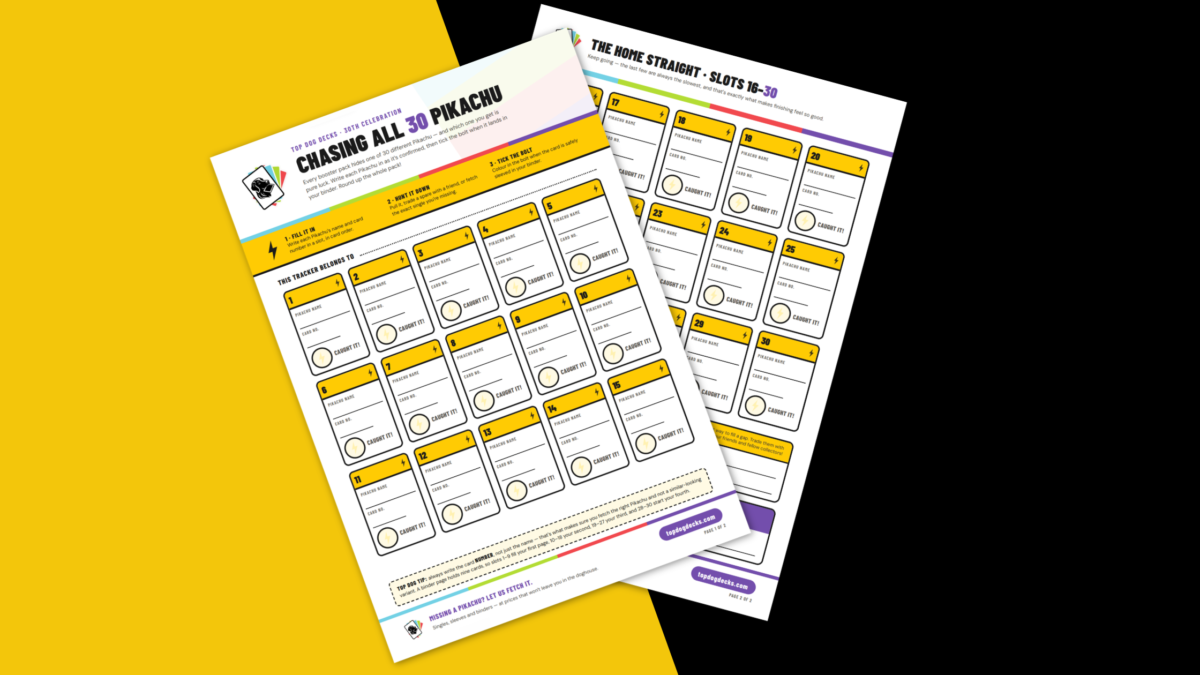
We’ve put together a free downloadable PDF tracker you can print at home. It’s bright, colourful, and designed to be fun to fill in, with a slot for each of the 30 Pikachu, space to write the card name and number, and boxes to tick or colour in as each one lands in the binder.
Download the free 30th Celebration Pikachu tracker (PDF)
We’ve built it as a fill-in tracker rather than a fixed list of names, and that’s deliberate. Card names and numbers are confirmed in stages ahead of and after release, so a pre-printed list can go out of date within weeks. A tracker you complete as each card is confirmed stays accurate for the whole challenge, and writing the names in is a job most kids genuinely enjoy.
How to fill in the card names
Before you print it, spend ten minutes gathering the details with your child. It’s a nice little research task in itself.
1. Check the official Pokémon TCG expansions and card browser or the set list printed on the product you already own, and write down each Pikachu’s name and card number.
2. Cross-check against a full community card list such as Bulbapedia’s 30th Celebration page), which is updated as each card is confirmed.
3. Compare with our 30th Celebration Pikachu singles listings, which show the exact card names and numbers we currently have in stock.
4. Write the entries in card order, so the tracker matches how the cards will sit in the binder.
Using the real card numbers matters more than it sounds. When you come to buy a single, the number is what confirms you’re fetching the exact card you need rather than a similar-looking variant or reprint.
Keep this Pokémon anniversary Pikachu checklist somewhere the whole family can see it, like the fridge or the front of the binder. Watching the boxes fill up is half the fun, and the “how you got it” column quietly builds a little history of the collection: pulled from a pack, bought as a single, or traded with a friend at league.
Why singles keep the challenge focused
Given how the 30 Pikachu are distributed, singles are the practical route for most families. Open a few packs for the thrill of it, absolutely, then use singles to close the gaps that packs keep refusing to fill.
A sealed-only approach brings more duplicates, more disappointment when the same Pikachu turns up for the fourth time, and a much bigger overall spend for a less predictable outcome. Singles let you fetch exactly the numbers still blank on your tracker, so you spend more time celebrating progress and less time repeating it.
A simple budget approach for families
You don’t need to buy everything at once. A slower pace is usually better for children anyway.
1. Set a monthly collecting budget and stick to it.
2. Pick two or three slots from the tracker to aim for each month.
3. Save sealed product for birthdays and treats rather than making it the main strategy.
4. Use duplicate Pikachu for trading, which is often the cheapest way to fill a slot.
This keeps the collection feeling achievable even when you’re working through it card by card. If you’d like a fuller picture of what the hobby tends to cost, our parent’s budget guide to starting kids in the Pokémon TCG breaks the numbers down properly.
Make the tracker fun
A visible tracker keeps children engaged long after the launch-week excitement wears off. Our printable PDF works well as it is, but you can adapt it to suit your child’s age.
Tracker ideas that actually work
A good family tracker should be easy to use, not another bit of admin for parents to manage. Try one of these:
- The printed PDF pinned up somewhere obvious, with boxes ticked in pen as each card lands
- A colour-in approach, filling in one Pikachu slot at a time with felt tips
- A second copy stuck to the front of the binder, so the tracker travels with the cards
- A binder page with labelled slots, so the gaps are the checklist
- A digital copy of the PDF for older kids who prefer a phone or tablet
Younger children often find the ticking off is the reward in itself. Older ones may enjoy tracking card condition too, or noting the price paid so they can see how the budget is holding up.
Binder pages make the collection feel special
There’s something very satisfying about seeing all 30 lined up together, especially when each one has a different holofoil pattern catching the light. A binder turns the set into a proper display rather than a pile of cards in a box.
It also helps children learn to organise. They can see where the gaps are, what’s already collected, and how close they are to finishing. That visual progress is often what keeps the excitement going through the slow middle stretch.
For more on this side of things, our guide to organising your child’s card collection is a good place to start.
What kids learn while collecting
This is where the fun has a quiet bonus. A family collecting project teaches a lot without feeling like a lesson, and the Pokémon TCG is surprisingly good at building maths and reading skills along the way.
Goal-setting and patience
Working towards a defined set teaches children how to plan a long-term goal and see that big results come from small, steady steps.
It works on grown-ups too. We’re slowly collecting every English Ninetales card here at Top Dog Decks, and it’s the tracker rather than luck that keeps that one moving forward.
Delayed gratification
Not every card appears straight away. Sometimes you wait, save, or trade before the right one arrives, and that’s genuinely useful practice. Children who learn to wait for the specific card they need, rather than grabbing the first shiny thing in front of them, build a far more thoughtful relationship with collecting.
Trading and community
With a guaranteed Pikachu in every pack, duplicates are inevitable across a whole playgroup, which makes this set brilliant for trading. Swapping spares teaches fairness, communication, and how to weigh up value in a practical way.
It also shows children that collecting is social. They’re part of a pack, and someone else almost certainly has the Pikachu they’re missing. If you’re looking for a broader starting point for younger collectors, our post on how to get your kids into the Pokémon TCG is a helpful companion read.
Protect the finished set so it lasts
Once those Pikachu start coming together, protect them properly. A complete set feels even more rewarding when it stays in good condition, and heavy holofoil cards show wear quickly.
At a minimum, we recommend:
- Penny sleeves for every card
- A ringless or side-loading binder
- Careful handling with clean, dry hands
- Storage away from heat, moisture, and direct sunlight
If children are helping with the collection, make protection part of the routine from the first card. It teaches them that looking after a collection matters as much as finding the cards.
A nostalgic celebration for parents, too
The Pikachu are only part of the anniversary. Alongside the main set, the release also brings a Classic Collection of 30 reprinted cards spanning Base Set through to modern sets, as confirmed in the official 30th Celebration product showcase. That’s a lovely excuse to show your child the cards you grew up with.
It’s a rare chance to compare memories, talk about your own favourites, and demonstrate that collecting can be thoughtful, patient, and fun all at once. It isn’t just about finishing a set. It’s about building a small family tradition around it.
Ready to round up the whole Pikachu pack?
Download and print the free tracker, fill in the names and numbers together once they’re confirmed, then work through the blank slots with singles rather than hoping the right Pikachu turns up in a pack. That keeps the project fun, affordable, and genuinely finishable.
